|
Getting your Trinity Audio player ready...
|
Most Activations Happen Very Few Actually Land
There is a distinct difference between conducting a brand activation campaign and one that works. The process involves entering a space, setting up something branded, and displaying the product within the space. However, the results are quite different, and the distinction between a campaign that works and one that is conducted can usually be seen even before Day One arrives.
What makes a brand activation campaign work is not luck or even the size of the budget involved. This is due to careful considerations about the goals, target audiences, formats, execution, and measurement made early in the process. The process of making these decisions well leads to campaigns that create memories for the consumer, conversations, and actions, while poor or non-existent planning makes any campaign with even the most impressive setup almost meaningless. This guide presents a realistic view of what makes a brand activation campaign really work.
It Starts With a Goal That Is Actually Specific
Most brands will tell you what they expect from a brand activation, and the typical response will be that they want to increase awareness or get consumers to engage with their products. These are directions rather than goals, and without any destination in mind, there are no results.
A successful brand activation begins with a goal that is precise enough to be measured. Not awareness, but a very specific number of new consumer tests in a very specific location over a very specific period of time. It’s not participation, but a redemption rate on a promotion mechanic, or a footfall target for an activation zone, or a content creation metric in a social sharing experience element.
The specific goal will define the specificity of the strategy. If you have a very clear picture of success, then every decision after that will be measured against it. But if your goal is ambiguous, then any decision is as good as the next one.
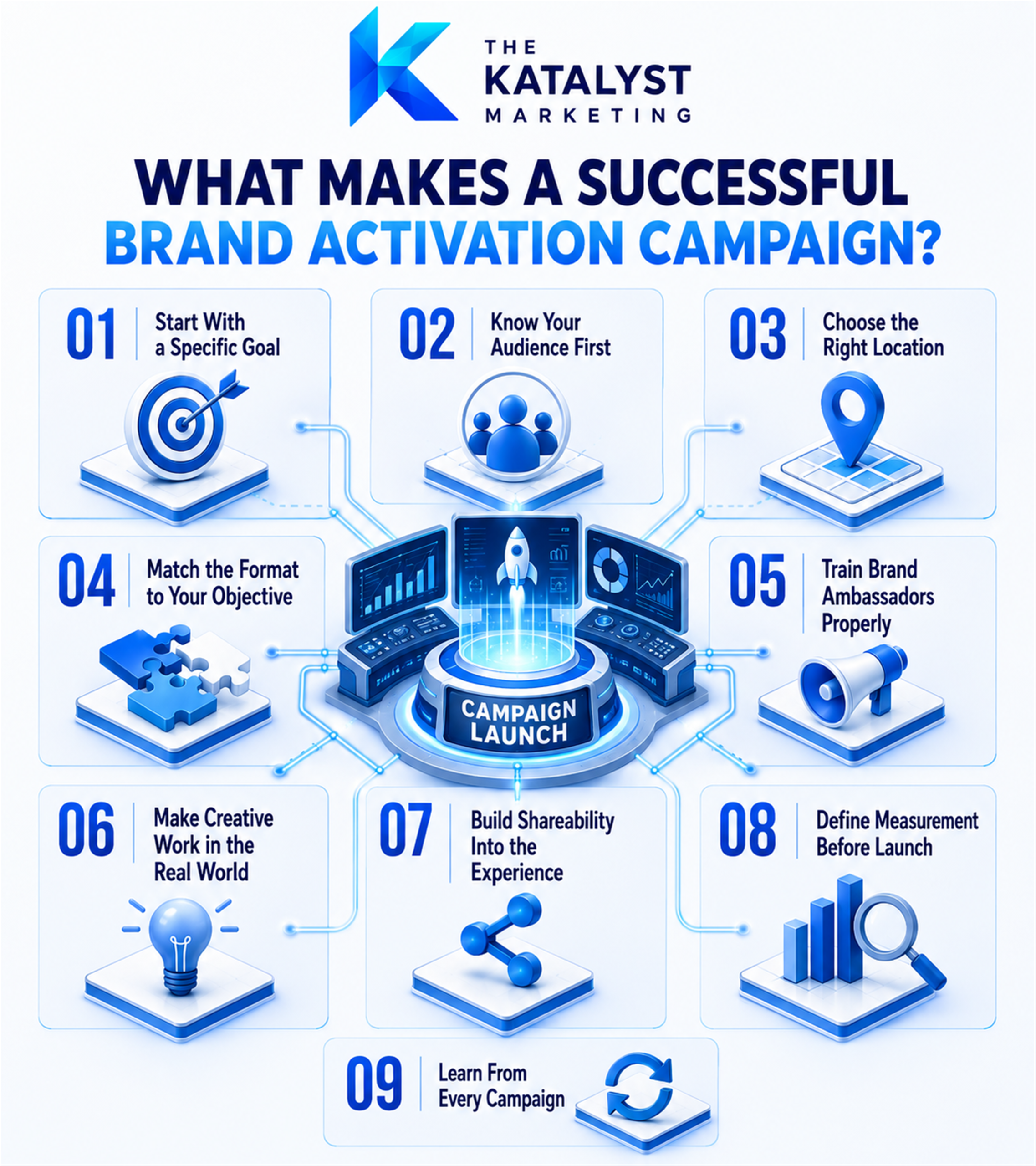
The Audience Comes Before the Concept
Know Who You Are Activating For Before You Decide How
One of the most common sequencing mistakes in marketing activation strategy is developing the creative concept before deeply understanding the audience. An idea that might be quite thrilling inside the meeting room may be dead in the field, as it has been conceived keeping the needs of the brand in mind instead of those of the customer.
A brand activation campaign must begin with a clear idea of the consumer who will be targeted by the said campaign. It cannot be about any demographics; it has to be about a particular consumer. What does he/she buy? What is his/her shopping process like? Why do people like him/her stop at something? What makes them pick an item? What would make them post about their experiences on social media?
Location Is a Strategic Decision, Not a Logistical One
The place of activation says something about your target consumer. The premium mall activation says something about your consumer. The hypermarket activation says something about your consumer. Community markets or sporting events say something else entirely. Nothing is wrong here, but picking the wrong place for your audience will be one of the quickest ways to get foot traffic and no conversions.
Brand activation services that know what they are doing with location consider it from an audience perspective before anything else. The proper location for your activation is wherever your consumer spends their time already. It isn’t necessarily easy to book or flashy enough to look good on paper.
The Format Has to Fit the Goal
There is no single format that works for every experiential marketing campaign. This choice needs to be made based on the fact that this format is the best way to achieve this specific goal and not out of familiarity or imitation of competitors, and certainly not for ease of execution.
Product sampling campaigns require mechanics of this type that allow consumers to try the product, ideally assisted by specially trained brand ambassadors to facilitate the transition from sampling to purchase. Brand awareness campaigns require mechanics that allow attendees to take photos of the event and share them. Loyalty campaigns require mechanics that make current customers feel appreciated and give them an incentive to continue visiting.
Customer activation requires a proper match between mechanics and goal. An aesthetically pleasing brand experience that fails to drive the consumer towards the goal of the campaign, no matter how great it looks, is a campaign where aesthetics triumphed over strategy. Both are important. But strategy has to win.
Execution Is Where Campaigns Are Won or Lost
Ambassador Quality Changes Everything
The brand ambassador is the human face of your brand activation campaign, and this will determine how good the consumer experience will be. Selecting the right ambassador, training them well, and ensuring that they are very passionate about the role can help convert an indifferent passerby into a trial customer and a trial customer into a loyal brand advocate. Poor selection and preparation can sabotage even a well-formulated campaign at each and every point of contact.
Training is an important part of the campaign process. It involves a lot more than just going through a checklist. The ambassadors must know the product completely, be able to answer any questions that may be thrown their way easily and confidently, and have the right kind of enthusiasm when interacting with consumers.
Creative Materials Must Work in the Real World
A creative that seems great on a slide may prove to be utterly useless in a real-life scenario. Difficult-to-assemble displays, poorly designed signs that shoppers cannot read easily from their natural sightlines, overly complicated mechanical promotions that require excessive explanation – all of these are examples of poor execution of the campaign, no matter how great its strategy is.
Those experiential brand experiences that prove to be successful time after time are the ones where the creative agency put effort into thinking about the practical use of the campaign materials in the given environment rather than just about how good they would look in a deck. Testing on a small scale is one of the cheapest investments that a company can make in its campaign.
Building Shareability Into the Experience
A brand engagement strategy that only reaches the people physically present at an activation is leaving a significant portion of its potential impact on the table. By 2026, the best activations will be conceived with two audiences in mind at once: those who experience the activation within the space itself and those who will see it on social media.
It does not mean having a separate social media budget or even an elaborate influencer campaign. All it means is crafting an experience that compels people to want to capture and share the experience for themselves because of its visual uniqueness, genuine fun, or surprise value that made it worth sharing with someone who did not experience it firsthand.
The fact that consumers take it upon themselves to share a branded experience on their own social media account without being prompted to do so creates social proof and organic reach that can never be replicated via paid media. And that is how activations will create impact and leave the room.
Measurement That Actually Tells You Something Useful
A brand activation campaign without a measurement framework is an activity without accountability. Without accountability, one cannot know what worked, what did not, and how it can be improved in the next iteration.
Measurement begins well before the campaign even starts by defining certain metrics in relation to certain goals. In the case of trial campaigns, these metrics include trial rate and conversion into purchases; for awareness campaigns, the metrics include reach, content production, and social engagement; for loyalty mechanics, the metrics include redemption rates and repeat purchase rates in the weeks after the campaign.
Activation concepts created with measurement at the forefront of development provide data that is actually actionable rather than mere information on how many samples were handed out or how many individuals passed through the location. Companies that develop this process into their DNA improve their results in each campaign due to the unique knowledge gained from each and every activation. If you are developing an activation campaign and want to start off on the right foot, contact our team today.
Conclusion
A brand activation campaign that genuinely works is not an accident. And that happens because of good thinking, proper setting of objectives, sound decision-making in consideration of the audience, solid execution, and smart measurement right from the start.
The brands that have a knack for creating successful activations do so by considering each activation as a commercial endeavor that comes with a clearly defined return, not a creativity project or simply an exposure effort. They focus on “why”; they revolve around “who,” and “how” is selected according to “what” works for the objective.
If you are ready to embark on the planning of your next brand activation campaign that will really deliver results and not just efforts, then get in touch with our team today. The Katalyst Brand Activation team collaborates with companies in the UAE and GCC to develop and deliver campaigns that deliver true consumer moments and true commercial success.