|
Getting your Trinity Audio player ready...
|
The Store Is Still Where Most Buying Decisions Are Made
Digital marketing can connect with a consumer while he/she is lounging on the couch. Social media can create familiarity after weeks and months of interactions. However, when this same consumer visits a supermarket, picks an item from a store shelf, and decides what to buy everything that happens during this process is a spontaneous decision and it occurs right there, on the spot.
The term in-store promotions describes the marketing processes happening in this exact moment. These are the means of influencing the decision of a consumer, when awareness about the brand and the product exists and all he/she needs is just a strong reason to make a purchase in favor of this brand.
For FMCG brands, consumer goods retailers and companies operating in the competitive environment, such as the UAE, the in-store promotion is a very powerful marketing channel.
What In-Store Promotions Actually Do for a Brand
There is a tendency to think of retail promotions as purely a sales tool something to rely on when you want a temporary volume boost. And they do generate volume. But the commercial effect of a carefully planned in-store promotion has another dimension beyond the period of the campaign.
If a customer has tried a product for the first time due to a promotion making the try easier, and if that product has lived up to expectations, the promotion did more than sell one unit – it brought another lifelong client to the brand. The long-term benefits coming from the customer’s future purchases and recommendations stem from the single moment of the promotion in-store.
The consumer promotions, thought about in these terms, as opposed to merely numbers during the week, have a multiplying commercial effect that a brand could use to grow.
Choosing the Right Promotion Format for the Right Goal
Trial Goals Need Trial Mechanics
Not all in-store promotions are built for the same purpose. Format selection must be determined purely based on the objective behind the promotion, and the greatest error companies commit is employing the same format across the board irrespective of its appropriateness.
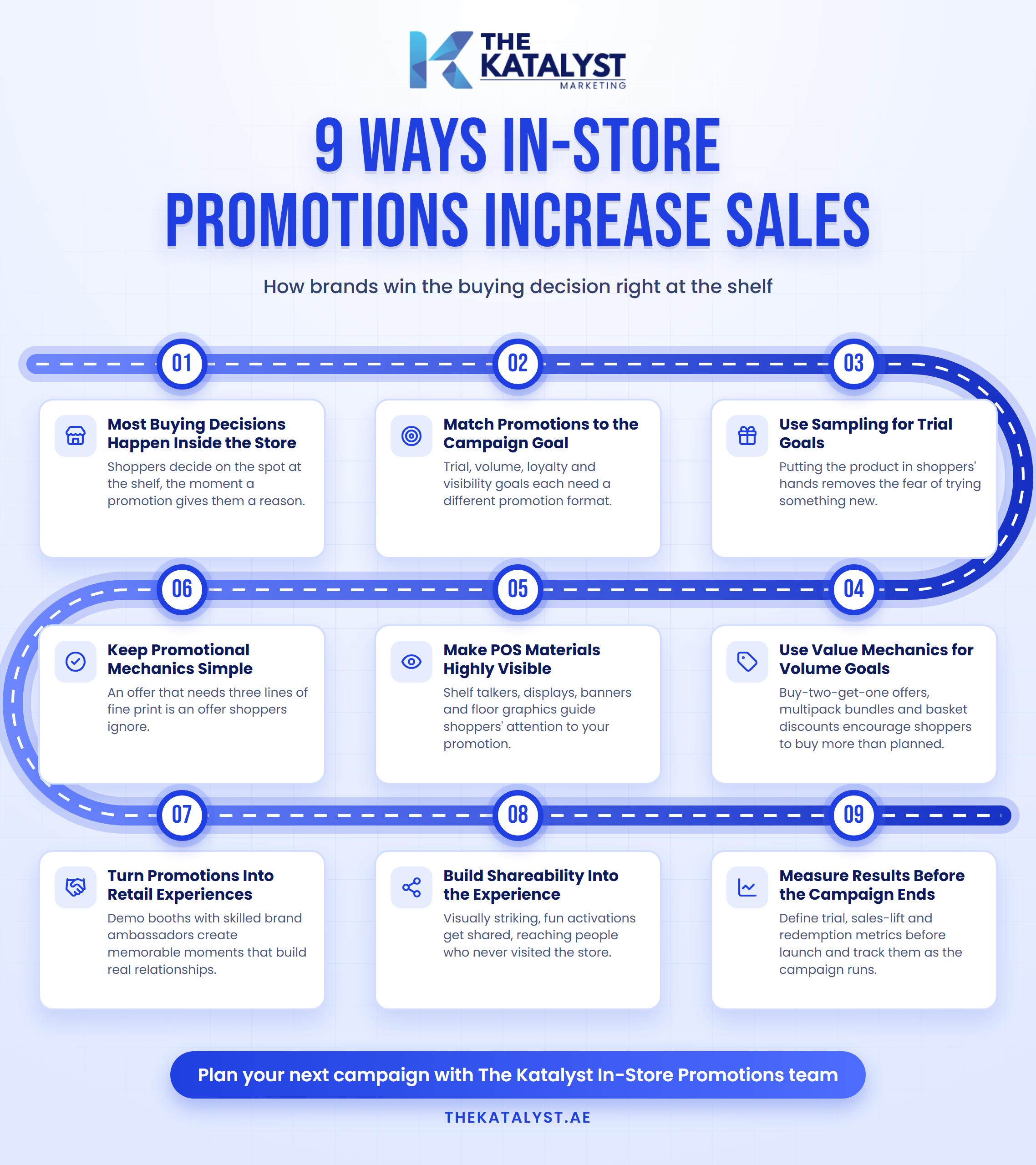
If the objective is attracting new consumers and making them try the product for the very first time, the most reliable mechanic will definitely be that of sampling the product. Placing the product in the hands of the consumer to sample or use it will help eliminate the fear of trying something new; it becomes the only factor standing between the consumer and the product.
Volume Goals Need Value Mechanics
Where the objective is the generation of purchase volume from a consumer who is aware of the product, price-based mechanics usually work well, although only when implemented properly. A buy two-get one offer, a cheaper multipack bundle, or a discount mechanism where discounts increase with basket size provides the consumer incentive to buy above their original intent.
FMCG Promotions based on volume mechanics must be designed in such a way that the promotion stands out and is easy to see. A promotion which makes the customer have to read three lines of fine print in order to comprehend what is being offered is simply not a promotion worth noticing.
The Role of Point of Sale Marketing in Promotion Success
A great promotion with poor point of sale implementation is an ignored promotion. Point of sale marketing is the actual physical aspect that helps to implement your campaign in the store, which is one of the main factors influencing the efficiency of a campaign.
All shelf talkers, branded displays, hanging banners, floor graphics and gondola end displays have the same basic function – they help to direct the shopper’s attention to your product and your promotion before they can actually choose to look somewhere else. When done right, they provide a route from the entrance of the store, through the shelves to the shopping cart that is both natural to the customer and beneficial for your business.
In-store marketing UAE campaigns which focus on point of sale marketing as part of the campaign itself instead of just relying on the product packaging as the only means of catching the buyer’s eye perform better than others. After all, there are dozens of other products trying to attract the buyer’s attention.
Retail Activation Taking In-Store Promotions Further
When Promotion Becomes Experience
Standard shelf promotions influence the shopper. Retail activation creates a moment that the shopper actually remembers. That is the distinction between a mechanic that triggers the sale versus the experience that fosters the relationship, and the most commercially successful campaigns in retail stores are those that manage to perform both in parallel.
A product demonstration booth manned by a good brand ambassador is more than a trial inducer. It represents a personal connection between the consumer and the brand that features warmth, authority, and humanness, things that a mere demonstration unit or sticker cannot provide. When consumers learn something about the product from someone who really knows it inside out, it goes beyond just learning about the product.
Creating Moments Worth Sharing
Retail marketing strategy in 2026 increasingly recognizes that the in-store experience does not have to stay in the store. Intricate activations that look visually interesting, are really fun, or offer a unique design provide consumers with a good enough reason to take photos and share it on their channels thus making the campaign available to people who have never even been inside that store.
Organic social sharing is a form of endorsement, and it has no equal in paid media because this is a person who is sharing their own experience with their audience. One of the best ways to boost the reach of the promotional campaign without increasing the budget is creating shareability from scratch.
What Separates Promotions That Work From Those That Disappoint
Many companies conduct in-store promotions and end up disappointed with the outcomes. They conducted the promotion; they sold some products and everything went back to how it was before. There is no sustainable impact. No new customers developed brand loyalty. Just a fleeting bump on the sales graph.
This happens because of the same reasons most of the time. The promotion objective was not defined clearly to select the right mechanic. The selection of location or stores did not fit the profile of targeted consumers. The materials at the point of sale were not visible or appealing enough to make the consumers stop. The mechanic itself was too complex for consumers to act on it.
Here is what the promotional campaigns that consistently perform well have in common:
- A single, specific goal driving every execution decision
- Store and location selection matched to the target shopper
- Simple, visible POS that communicates the offer instantly
- A mechanic that is easy to understand and easy to act on
- Trained brand ambassadors where human engagement matters
- A measurement framework defined before the campaign starts
Getting these fundamentals right does not require a larger budget. It requires sharper thinking before the campaign launches and a willingness to prioritize strategy over speed.
Keeping Promotions Consistent Across Multiple Locations
For brands running shopper marketing services across multiple stores or markets, consistency of execution is one of the biggest operational challenges It is also one of the most commercially important. An ad campaign that works fantastically in one place but is completely different in another place will be one that is only working at a small fraction of its true capabilities.
This is because consistency builds upon itself. In one situation, an individual is seeing your ad campaign in the Carrefour shopping center located in Dubai Marina, and then sees the same ad campaign in the Lulu Hypermarket in Abu Dhabi, and in both cases sees exactly the same thing communicating the same message. If the execution is different, the impression of the brand is different and the overall impact is not as strong.
Multi-location consistency needs standards of deployment, a properly trained field force, and reporting on the quality of the execution in real-time to identify any problems that may need to be addressed. The ability to do this effectively is what gives experienced retail activation agencies an edge in campaigns.
Conclusion
In-store promotions are some of the most powerful techniques that can be deployed by any brand wishing to market its products in a physical retail space. It is because they have a direct impact on the customer’s buying decision, give reasons to buy, encourage trials that result in loyalty and gather data for future marketing campaigns.
Those brands that derive the greatest benefit from their in-store promotions use them strategically, not tactically. They know what they want to achieve, how to achieve it and they have the right formats to deploy and measure the results.
If you are planning an in-store campaign and want to build it on the right foundation, speak with our team today. The Katalyst In-Store Promotions team works with FMCG and retail brands across the UAE and GCC to design and deliver promotional campaigns that genuinely move product from the strategy stage through to execution and measurement.