
|
Getting your Trinity Audio player ready...
|
Advertising Talks at People Experiential Marketing Talks With Them
There is a basic distinction between a consumer who knows your brand and one who has had a brand experience. One has received a message; the other, lived a moment. In a world where each individual receives tens of thousands of brand messages per day, it is the moment that becomes memorable.
Experiential marketing is the practice of creating those moments deliberately Creating experiences around your brand that are immersive and make the consumer the focal point instead of just the recipient. It is not a marketing effort that addresses an audience. It is one that invites an audience to participate.
The move away from passive consumption towards active involvement is what makes experiential marketing such a compelling proposition for business success. The relationship built when a consumer engages with your brand – by tasting it, by exploring it, by interacting with it, by feeling something through it is something fundamentally different from anything achieved through television or online.
Understanding What Experiential Marketing Actually Covers
The term gets used broadly, and it is worth being clear about what it actually includes. Experiential marketing is not a single format It is a marketing tactic that can come in numerous varieties according to the brand, the objective, and the target audience.
An example of an experiential marketing strategy is product sampling that allows consumers to see the product before purchasing it. An example of an experiential marketing strategy is a pop-up store that places the consumer in the middle of a brand’s universe. Another example of an experiential marketing strategy is a demonstration of a product at a consumer event. The thing that these examples have in common is one principle – the consumer is not only observing but taking part in something.
Experiential brand activation takes this even further by connecting the live experience directly to a specific campaign objective whether it be generating trials, creating awareness, launching products, building loyalty, or creating social content. It is only when the experience is created with a commercial aim in mind instead of a mere concept that it becomes truly meaningful.
The Science Behind Why It Works
Emotion Creates Memory and Memory Drives Decisions
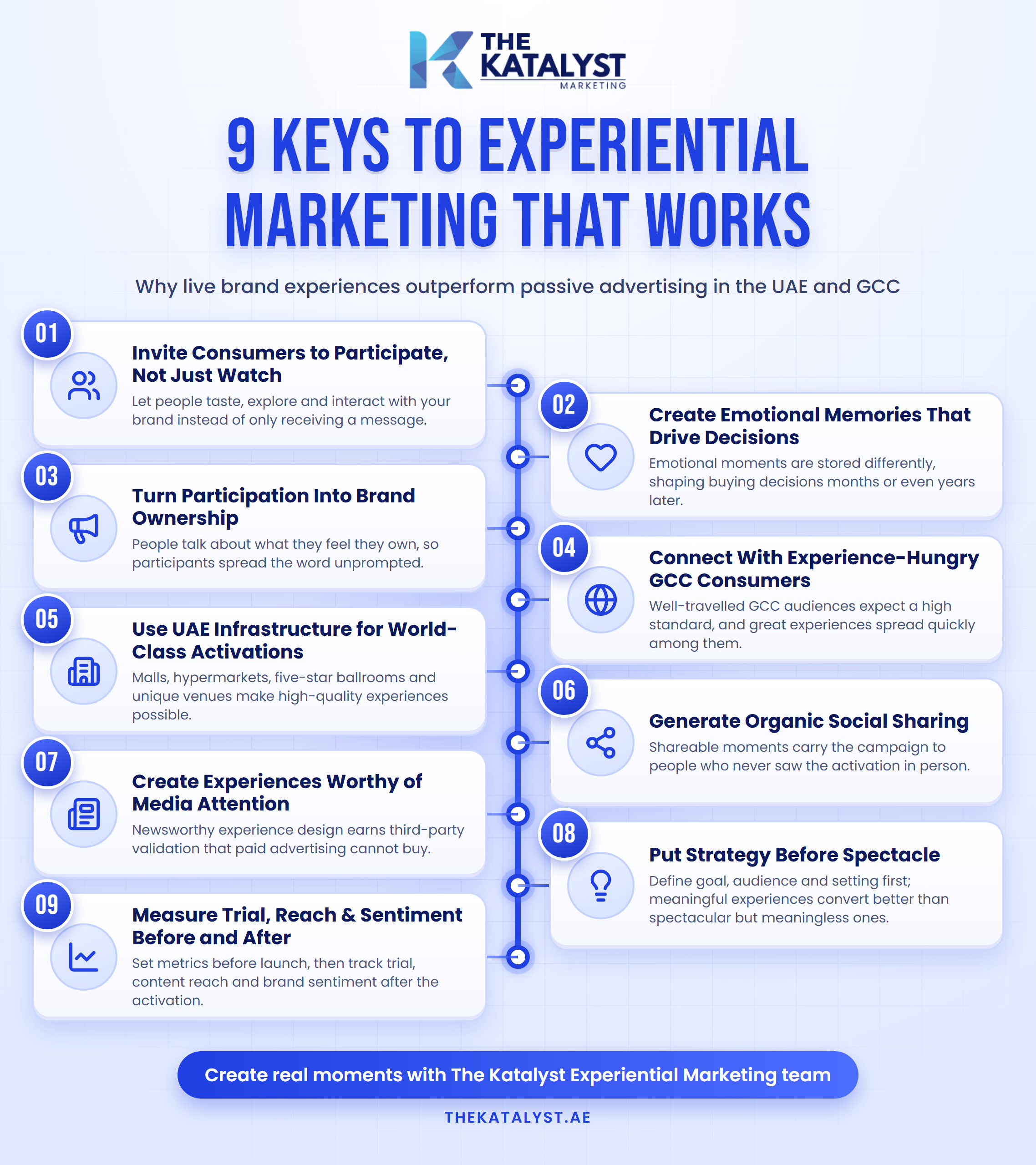
There is something specific about why some brand experiences become memorable over years, while others are forgotten within minutes after seeing the ad. The answer to the question lies in emotions. Any emotional reaction that the consumer might have towards the brand experience will result in the encoding of this experience by the brain into memory differently than neutral information.
Customer experience marketing campaigns based on emotion-based experiences always generate higher levels of brand memorability, purchase intention, and customer advocacy than campaigns centered on informative messages alone. This is not just a hypothesis or a suggestion; it is a proven fact in the consumer behavior research, backed up by statistics of experiential campaign results from all around the world.
Participation Creates Ownership
By becoming an active participant in the brand experience as opposed to merely watching it unfold, consumers create a feeling of personal involvement with the experience. In some way, shape, or form, they feel that they are stakeholders in whatever has happened. This psychological transformation from being an observer to being a participant is one of the most potent forces in experiential advertising and it is one of the major reasons why people talk about experiential campaigns.
People speak about the things that they feel they own. By taking an active part in an experience, whether that be a successful activation, an exciting brand experience, or an enjoyable experience, the consumer will tell other people about it in order to claim that the experience belongs to them. This kind of spontaneous support is the reason why experiential marketing becomes one of the channels that earns its audience rather than buying it.
Why the UAE and GCC Are Perfect Markets for Experiential Marketing
An Audience That Has Seen Everything and Still Wants More
In the GCC market, consumers are some of the most travelled, branded, and experience-demanding customers in the whole world. Consumers in markets such as Dubai, Riyadh, and Abu Dhabi have attended premium experiences and witnessed top global brand marketing events in premium locations. These are customers who really know a lot; and therefore, the standard required to grab their attention is high.
Marketers who can create experiential marketing GCC campaigns with the required level of creativity and quality to match the high expectations of these consumers will get the desired level of engagement that others cannot provide. The difficulty associated with the GCC market is actually the strength. A good brand experience in the GCC market spreads quickly as these customers are very much connected and vocal about what they see and hear.
World-Class Infrastructure Built for Experiences
UAE boasts some of the best facilities when it comes to event and retail infrastructure. The malls are big and beautifully constructed. From a five-star hotel ballroom to unique venues that can accommodate thousands of people, everything exists in this beautiful region. The environments in which the brand activation is done in hypermarkets and shopping complexes are amongst the best in the global arena.
The experiential marketing Middle East campaigns greatly enjoy this kind of environment. The physical spaces available for the brands in the UAE help to make experiences possible not only at an incredible level but also with high quality that would be difficult to obtain in many other markets. The audiences that occupy these spaces have great interest in trying out brand experiences – something very desirable in the context of experiential marketing.
What Experiential Marketing Does That Other Channels Cannot
Brand experience campaigns create outcomes that no other marketing channel consistently delivers It is the comprehension of such results that enables brands to make their case for experiential marketing within their organizations and to assess the value of their efforts realistically.
The first one is product trial. If a person uses a product himself – tastes, wears, applies, smells – his resistance to purchasing it for the first time drops considerably. An actual trial experience that a consumer gets has more credibility than any picture of a product displayed on the screen can have.
The second is organic social reach. A well-designed experiential campaign gives consumers something genuinely worth sharing a moment to be seen, a surprising encounter, an enjoyable experience that they wish to tell their friends and followers about. In this case, the campaign gets credibility and reach to people who did not see the activation in person.
The third thing that happens when you create a truly amazing experience for your audience is gaining media attention. When you make your campaign truly remarkable and news-worthy, you gain attention that no amount of paid advertisement can give. A brand that creates something worthy of being talked about through its experience design gains third-party validation and gets transformed.
And finally, the last thing we can get from creating an experiential campaign is a long-term brand memory. After the campaign finishes and the digital posts are updated with new ones, consumers who experienced your brand live will have the memory of it. They will use this experience to decide about buying your product months or even years after the campaign ends.
Making Experiential Marketing Work for Your Brand
Strategy Before Spectacle
The most effective experiential campaigns are not necessarily the most complex. They are the campaigns constructed upon the best strategy. The campaign goal should be determined first; the goal should be defined precisely and honestly. What is the aim of this campaign? To whom exactly will this campaign be directed? Where do the people go and what experience would appeal to them?
Experiential campaigns, which have been conceived in response to these questions, offer meaningful experience rather than only visually impressive one. And meaningful experiences are more likely to be converted than spectacular but meaningless ones.
Execution Quality Determines the Brand Impression
In experiential marketing, the experience becomes the brand message. Everything from the way the campaign is set up through quality materials used, through to training and warmth of brand ambassadors as well as experience flow and environmental detailing sends a direct message about the brand. A perfectly designed activation which fails to execute effectively makes a poorer impression than a more simple activation which executes perfectly.
Event marketing UAE teams that understand this put just as much emphasis on execution as they do on design, because once the consumer is there at an experience event, there is no editing afterwards.
Measuring Experiential Marketing Results
One of the questions brands most often ask about experiential marketing is how to measure it. The answer is just the same as with any other kind of marketing investment – set your metrics prior to the launch of your campaign, track them in a proper way, and measure them later on.
For trial-based experiential campaigns, track the rate of trial and conversion to purchase in the period after the activation. For awareness and social campaigns, measure the amount of content produced, achieved reach, and the quality of the engagement. For brand sentiment campaigns, track shifts in the discussion of your brand in the period after the activation. And for relationship building campaigns, track follow up conversations and commercial discussions initiated after your activation.
The metrics that are available to track in experiential marketing campaigns are not as immediate as a cost per click in a digital campaign – but are no less important. Those brands who establish a solid practice of measurement of their experiential activities in time start to see what works and what does not and use this information to improve their performance and create an ever-improving portfolio of experiences. If you want to build an experiential marketing strategy that is grounded in clear goals and honest measurement, talk to our team now.
Conclusion
Experiential marketing works because it does something that no other channel can do as consistently or as powerfully it gives the customer a sense of something tangible, which they will remember. In a world where people’s time is precious and advertisements abound, it is the experience that gets through.
The brands that spend their efforts on crafting experiences not only develop stronger ties with customers but also inspire organic advocacy and develop brand memory which goes beyond the boundaries of the campaign period. In countries such as the UAE and GCC region where customers crave experiences and where the infrastructure supports them, the opportunity is bigger than ever.
If your brand is ready to move beyond advertising and into experience, reach out to our team today. The Katalyst Experiential Marketing team works with brands across the UAE, Saudi Arabia, and the wider GCC to design and deliver campaigns that create real consumer moments and deliver real commercial results from the first brief to the final report.