
If You Cannot Measure It, You Cannot Defend the Budget
Every brand manager in the GCC has faced the same meeting. The activation looked great, the promoters were busy all weekend and the photos were strong. Then finance asks one simple question: what did we actually get back? That is the moment when BTL marketing ROI stops being a theory and becomes the most important number in the room.
BTL marketing covers everything that reaches the shopper directly and personally: sampling, in-store promotions, product demonstrations, mall activations, gondola ends, promoters and point-of-sale materials. Because these campaigns happen close to the moment of purchase, they are actually some of the easiest marketing activities to measure. The problem is rarely that measurement is impossible. The problem is that it was not planned before the campaign started.
This guide explains how brands in the UAE, Saudi Arabia and the wider GCC can measure the return from BTL and in-store campaigns properly, which metrics matter and which mistakes make the numbers look better or worse than they really are.
Why BTL Campaigns Are Often Judged Unfairly
Many in-store campaigns are judged on what is easy to count rather than what matters. The number of samples handed out, the number of people who stopped at the stand or the number of photos posted are all useful activity figures. On their own, they do not prove a commercial result.
The opposite mistake is just as common. A campaign is judged only on sales during the activation days, and every other effect is ignored. A sampling campaign that brings in new buyers who return to the shelf for months is not a failure because the weekend sales spike was modest.
Fair BTL campaign measurement looks at both the short-term sales effect and the longer-term behaviour change, and it compares both against what would have happened without the campaign.
Step 1: Define the Objective Before You Define the Metric
Every in-store campaign should have one main objective. The objective decides the metric, not the other way around.
- Trial: getting new shoppers to try the product for the first time.
- Sales lift: increasing units or value sold during a set period.
- Switching: winning shoppers from a competing brand.
- Loyalty: increasing repeat purchase among existing buyers.
- Visibility: securing better shelf presence and brand recall in store.
A campaign that tries to achieve all five at once usually ends up proving none of them. Choose the main goal, agree on it with the retailer and the internal team, and write down the number that will show success.
Step 2: Set a Baseline and a Comparison Group
Return on investment is always about the difference a campaign made. To know the difference, you need to know what normal looks like.
Use Historic Sales as the Starting Point
Collect sell-out data for the same stores for the weeks before the campaign. Where possible, also look at the same period last year, because seasonal moments such as Ramadan, Eid, National Days and back to school can change shopping patterns sharply in the GCC. Comparing a Ramadan activation against an ordinary month would exaggerate the result.
Compare Test Stores With Control Stores
The most reliable method for in-store marketing ROI is a test and control comparison. The campaign runs in a group of test stores, while a similar group of stores of the same retailer, size and area receives no activation. The difference in sales growth between the two groups is the incremental effect of the campaign. This removes much of the noise from weather, pay days, competitor activity and general market trends.
Step 3: Choose the Right Metrics for BTL Marketing ROI
Once the objective and baseline are clear, the next step is to track the metrics that connect activity to outcome. The best retail marketing analytics combine three layers.
Activity Metrics
These show whether the campaign was delivered as planned: number of activation days and hours, stores covered, consumers engaged, samples distributed and promoter attendance. They do not prove ROI, but without them you cannot explain the results.
Response Metrics
These show how shoppers reacted: trial-to-purchase conversion at the stand, coupon or voucher redemption, QR code scans, sign-ups, leads collected and the cost per engaged consumer. Unique codes and dedicated QR links make it possible to connect a specific activation to a specific action.
Business Metrics
These show the commercial result: incremental units and value sold, change in market share within the category, repeat purchase in the weeks after the campaign and any change in the retailer’s willingness to give extra listings or display space.
Step 4: Calculate the Return Honestly
The basic formula for brand activation ROI is simple:
ROI = (incremental gross profit generated by the campaign minus total campaign cost) divided by total campaign cost.
Two details make a big difference. First, use incremental gross profit, not total revenue. Revenue that would have come anyway is not a return, and revenue without the cost of goods removed overstates the result. Second, include every cost: agency fees, promoter staffing, stand production, samples and stock given away, retailer fees for space and any media used to support the activation.
For campaigns where the main goal is trial or loyalty, also look at the value of the new buyers over a longer period. If repeat purchase data is available, the true return of a sampling campaign often becomes visible weeks after the stand has been removed.
Where to Get the Data in the GCC
Shopper marketing ROI depends on access to good data, and that access varies by retailer and market. Useful sources include:
- Retailer sell-out or EPOS data, shared under a joint business plan
- Retailer loyalty programme data, where the retailer offers it to suppliers
- Distributor shipment data, to confirm stock levels before and after
- Promoter reports and digital tablets used to record interactions at the stand
- Unique promo codes, receipts uploaded for rewards and QR code scans
- Short shopper surveys before and after the campaign to track recall and intent
Agreeing on data sharing with the retailer before the campaign starts is one of the most valuable steps in the whole process. Once the activation is over, it is much harder to request.
Common Mistakes That Distort the Numbers
Ignoring the Dip After the Promotion
Price-led promotions often cause shoppers to stock up. Sales rise during the campaign and then fall below normal in the following weeks. If you only measure the campaign period, the result looks better than it was.
Forgetting Cannibalisation
If a promotion on one pack size simply moves shoppers away from another pack size of the same brand, total brand sales may not grow at all. Measure the whole brand, not only the promoted item.
Not Checking Stock and Execution
An activation in a store where the product ran out of stock on day two will show poor results for reasons that have nothing to do with the idea. Store audits and promoter reports help separate a weak concept from weak execution.
Turning Measurement Into Better Campaigns
The real value of measuring experiential marketing ROI is not the report itself. It is what the next campaign learns from it. Over time, brands that measure consistently can see which stores, which days, which mechanics and which formats deliver the strongest return in each GCC market. That knowledge turns BTL from a cost line into an investment that can be planned with confidence. If you want your next in-store campaign built with measurement from day one, talk to our team.
You can also read our complete guide to BTL marketing and our article on how in-store promotions increase sales for more ideas on planning campaigns that perform.
Conclusion
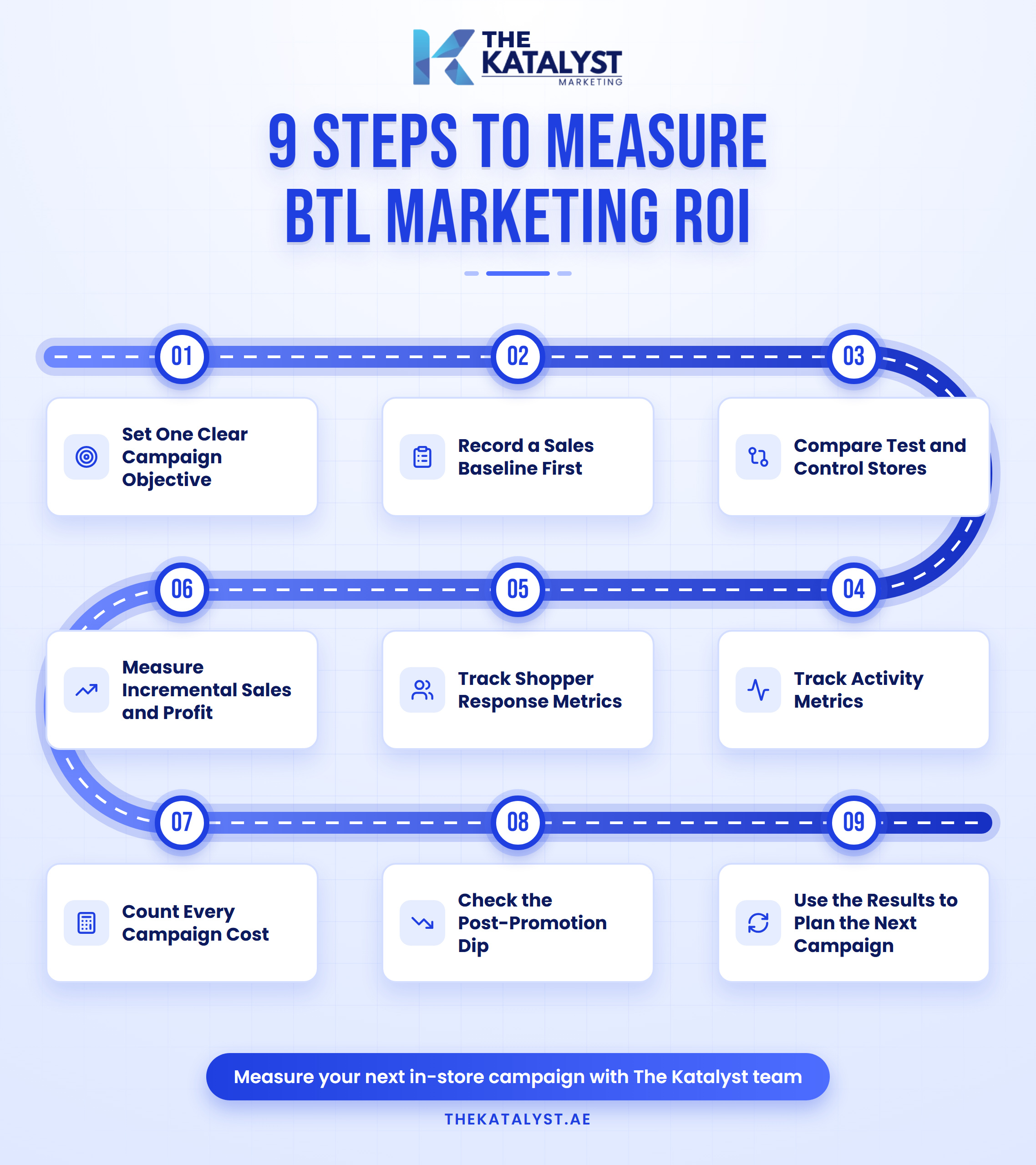
Measuring BTL marketing ROI is not complicated, but it does require discipline. Set one clear objective, record a baseline, compare test stores with control stores, track activity, response and business metrics, and calculate the return using incremental profit and full costs. Do this consistently and every campaign becomes smarter than the one before it.
If you are planning a BTL or in-store campaign in the UAE, Saudi Arabia or across the GCC and want clear answers on what it delivers, reach out to our team today. The Katalyst works with brands across the region to plan, deliver and measure activations that show real commercial results, from the first brief to the final report.
FAQs
Q1. What is BTL marketing ROI?
BTL marketing ROI is the return a brand earns from below-the-line activities such as sampling, in-store promotions and activations, compared with what those activities cost. It is best calculated using the incremental gross profit created by the campaign, minus the full campaign cost, divided by that cost.
Q2. How do you measure the ROI of an in-store promotion?
Start with a baseline of normal sales, run the promotion in test stores while keeping similar control stores unchanged, and compare sales growth between the two groups. Then deduct all campaign costs from the incremental profit and check the weeks after the promotion for any sales dip.
Q3. Which metrics matter most for brand activation ROI?
It depends on the objective. Trial campaigns should focus on trial-to-purchase conversion and repeat purchase. Sales campaigns should focus on incremental units and value. Visibility campaigns should track shelf presence and brand recall. Activity figures such as samples distributed support the analysis but do not prove a return on their own.
Q4. Can experiential campaigns be measured if they do not sell on the spot?
Yes. Use unique codes, QR scans, lead capture, short surveys before and after the campaign and repeat purchase data to connect the experience to later behaviour. Setting these tracking tools up before launch is essential.
Q5. Why should brands in the GCC agree data sharing with retailers before a campaign?
Store-level sell-out data is the most reliable proof of sales impact, and retailers are far more likely to share it when it is part of the agreed campaign plan. Asking after the activation often means incomplete or late data.