In a Crowded Market, Being Seen Is Not the Same as Being Remembered
Walk through any major mall in Dubai, Riyadh or Doha and you will see dozens of brands competing for the same few seconds of attention. Screens, banners, promotions and offers all fight for the same shopper. Most of them are seen. Very few are remembered. This is exactly where experiential marketing Middle East brands invest in makes the difference, because it gives people something to do with a brand instead of something to look at.
Standing out in the region is no longer about being the loudest. It is about being the brand people actually experienced, talked about and chose to return to. When a consumer tastes, tries, plays or takes part, the brand stops being one message among hundreds and becomes a moment they own.
In this article, we look at why standing out has become harder in the GCC, how experiential marketing creates real difference, the formats that work best in the region, and how to make sure your experience leaves a lasting mark. If you are new to the idea itself, start with our guide on what experiential marketing is and why it works.
Why Standing Out Has Become Harder in the GCC
The UAE and the wider GCC attract global and regional brands in almost every category. New launches arrive constantly, and many of them compete in the same places: the same malls, the same hypermarkets, the same social feeds and the same seasonal moments such as Ramadan, Eid, National Day celebrations and major shopping festivals.
When everyone is active at the same time, campaigns start to look alike. Discounts are matched within days. Digital ads are scrolled past. Shelf space is crowded. For many brands, the result is plenty of activity but very little that actually separates them from their competitors in the mind of the consumer.
Consumers in the region are also well traveled and highly connected. They have seen premium brand experiences around the world, and they quickly notice when something feels generic. To stand out, a brand needs to offer something that cannot be copied in a week and cannot be ignored on a phone screen.
How Experiential Marketing Middle East Campaigns Create Real Difference
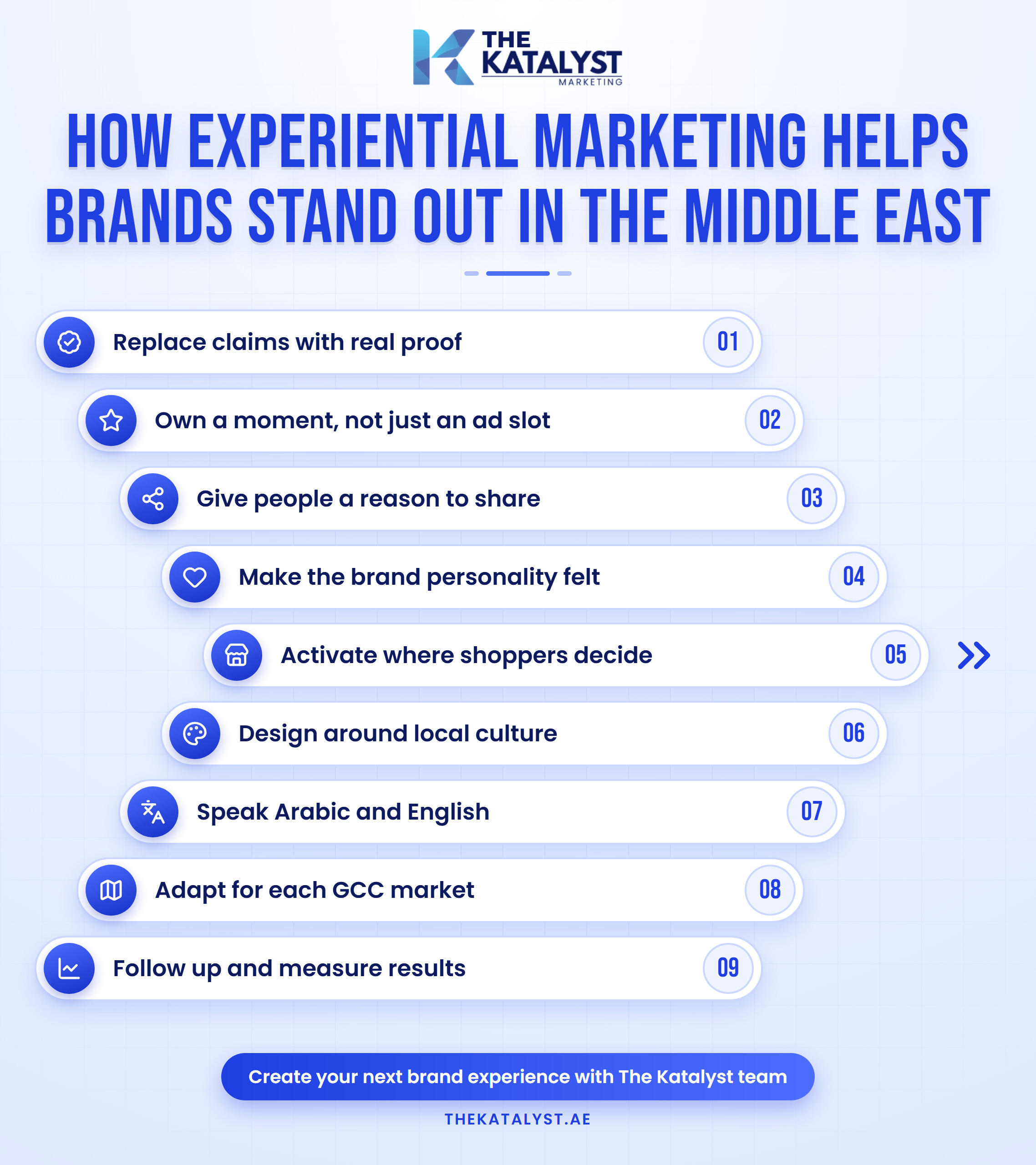
Experiential marketing works because it changes the relationship between the brand and the consumer. Instead of telling people what to think, it lets them discover it for themselves. Here is how that creates difference.
It Replaces Claims With Proof
Every brand says it is better, fresher, faster or more premium. Very few let people prove it on the spot. A sampling station, a live product demonstration or a hands-on trial turns a claim into a personal experience. When a consumer feels the difference themselves, the brand no longer has to convince them.
It Owns a Moment Instead of Renting Attention
Advertising rents a few seconds of attention. A well-designed experiential brand activation owns a moment in someone’s day: a game they won, a product they created, a conversation with a knowledgeable brand ambassador. That moment belongs to your brand alone, and it is far harder for a competitor to match than a price cut.
It Gives People a Reason to Share
People share what surprises or delights them. An experience that is visual, personal or interactive naturally creates photos, videos and stories that travel far beyond the people who attended. The brand earns reach through its audience rather than only buying it.
It Gives the Brand a Personality People Can Feel
Two brands can have similar products, similar prices and similar packaging. What separates them is how they make people feel. A brand experience agency Dubai teams work with can translate brand values into color, sound, space, service and interaction, so the brand’s personality is something consumers feel and not just something written in a guideline.
Experiential Formats That Help Brands Stand Out in the UAE and GCC
The right format depends on your objective, your audience and where they spend their time. These are the formats that tend to work well across the region:
- In-store activations and sampling: engaging shoppers at the point of purchase, when the buying decision is being made.
- Mall pop-ups: temporary branded spaces in high-traffic malls that let people explore a product or a story.
- Gamified experiences: games, challenges and digital interactions that reward participation and keep people engaged for longer.
- Product launch events: experiences that introduce a new product to media, partners, influencers and consumers at the same time.
- Roadshows: one experience taken to several locations or cities to reach different audiences.
- Culturally rooted experiences: activations designed around local traditions, heritage and seasonal moments.
- Influencer-led experiences: live experiences that creators attend and share, extending reach to their followers.
- Purpose-led and community programs: awareness campaigns in schools, communities or wellness spaces that connect the brand to something people care about.
Each of these formats can be combined with others. For example, a mall pop-up can include a game, product trial and influencer visits, all supported by in-store promotions nearby. To see what separates strong activations from forgettable ones, read our article on what makes a successful brand activation campaign.
Designing Experiences for Middle East Audiences
An experience that works in one market will not always work in another. Experiential marketing GCC campaigns stand out when they are designed for the people who will actually take part.
Respect Culture and Timing
Culture shapes how people engage with brands in the region. Family-oriented experiences, hospitality, generosity and respect for traditions all matter. Timing matters too. Behavior around Ramadan, Eid and national celebrations is different from the rest of the year, and an experience should fit the mood of the moment. Our article on the role of culture in GCC consumer marketing explores this in more detail.
Speak to a Diverse Audience
The UAE is home to residents from many nationalities, so experiential marketing UAE campaigns need to feel open to everyone. Clear visuals, simple interactions and bilingual Arabic and English communication help an experience feel welcoming to everyone who walks past.
Adapt for Each Market
The UAE, Saudi Arabia, Qatar, Kuwait, Bahrain and Oman share much in common, but each has its own audience, venues and approval processes. A strong concept can travel across the region, but the details should be adapted for each country rather than copied.
Choose the Right Environment
Climate shapes where people spend their time. During the hotter months, malls and indoor venues often become the natural home for activations, while outdoor experiences tend to suit the cooler season. Choosing the right environment helps the experience reach people where they already are.
Customer Experience Marketing: Keeping the Connection Going
The activation itself is only the beginning. Brands that truly stand out use customer experience marketing to keep the relationship going after people leave.
That can mean inviting participants to join a loyalty program, sending a follow-up offer to those who opted in, sharing event content that people can tag themselves in, or directing them to the nearest store to buy the product they just tried. Every step should make it easy for a consumer to move from a great moment to a real purchase.
Strong consumer engagement UAE campaigns also connect the live experience to digital channels before, during and after the activation. Teasers build anticipation, live coverage extends reach, and follow-up content keeps the brand present long after the set has been taken down. This is where event marketing GCC plans and digital plans work best as one plan rather than two.
How to Know If Your Experience Helped You Stand Out
Standing out should be measured, not assumed. Before the experience goes live, agree on what success looks like and how you will track it. Useful measures include:
- Participation: how many people took part, not just how many walked past.
- Time spent: how long people stayed engaged with the experience.
- Trial and sales: product trials during the activation and sales in the following period.
- Data and opt-ins: how many participants chose to stay in touch with the brand.
- Content and conversation: photos, videos, posts and mentions created by participants and media.
- Brand perception: how people describe the brand after the experience compared with before.
Measuring these results helps you prove the value of the campaign and makes every future experience sharper than the last.
Frequently Asked Questions
Is experiential marketing only suitable for large brands?
No. The scale can change, but the principle stays the same. A focused in-store activation or a small pop-up can help a growing brand stand out as effectively as a large launch event, as long as it is built around a clear objective.
How is experiential marketing different from traditional advertising?
Traditional advertising sends a message to an audience. Experiential marketing invites the audience to take part, which creates a personal memory of the brand rather than a passing impression.
Can experiential marketing work alongside digital campaigns?
Yes, and it usually works best that way. Digital channels build awareness before the experience, extend its reach during it and keep the conversation going afterwards.
Which industries benefit most in the Middle East?
Categories where trial and feeling matter, such as food and beverage, beauty, personal care, health and wellness, technology and automotive, often see strong results. Any brand that needs people to try, feel or understand its product can benefit.
Conclusion
In a region where brands compete in the same spaces and at the same moments, the ones that stand out are the ones people remember experiencing. Experiential marketing Middle East campaigns replace claims with proof, give people a reason to share and give a brand a personality consumers can feel. When they are designed for local culture, adapted for each market and connected to what happens next, they create a difference that competitors cannot copy overnight.
If you want your brand to be the one people remember, talk to our team today. The Katalyst plans and delivers experiential marketing and brand activation campaigns across the UAE and GCC, from the first idea to the final report. Get in touch with The Katalyst to start planning your next experience.