|
Getting your Trinity Audio player ready...
|
Ask most businesses what their main marketing channels are, and you’ll find out that social media, paid advertising, influencers, and email marketing are the answer. Events, on the other hand, are mentioned as something additional to be used for awareness or relationship building, yet are never thought of as the growth driver.
This approach is making businesses lose out on great opportunities. Event marketing, done with the proper strategy in place, is one of the most effective tools to build your brand reputation, qualify leads, engage customers, and generate long-term content.
The problem here isn’t events. The problem is in the approach most businesses take towards events. Instead of concentrating on what the event should help to achieve, they focus entirely on logistics — venue, catering, agenda, and other organizational aspects. This guide is all about changing this approach.
What Separates an Event That Grows a Business From One That Just Fills a Room
The difference between a corporate event that delivers real outcomes and one that simply happens comes down to one thing — strategic intent. Each decision made during the event planning process must be motivated by a clear commercial objective, rather than an idea of a successful event per se.
An event created to foster trial and exposure will differ dramatically from one that was developed to provide entertainment for current customers. The structure of a conference aimed at positioning the company as a leader in its field would be vastly different from the structure of a conference meant to bring sales leads to the audience.
Establishing the goal at the beginning is the most crucial element of the event marketing process. Once you have your goal clearly set, each other’s decision will be a lot simpler and more effective.
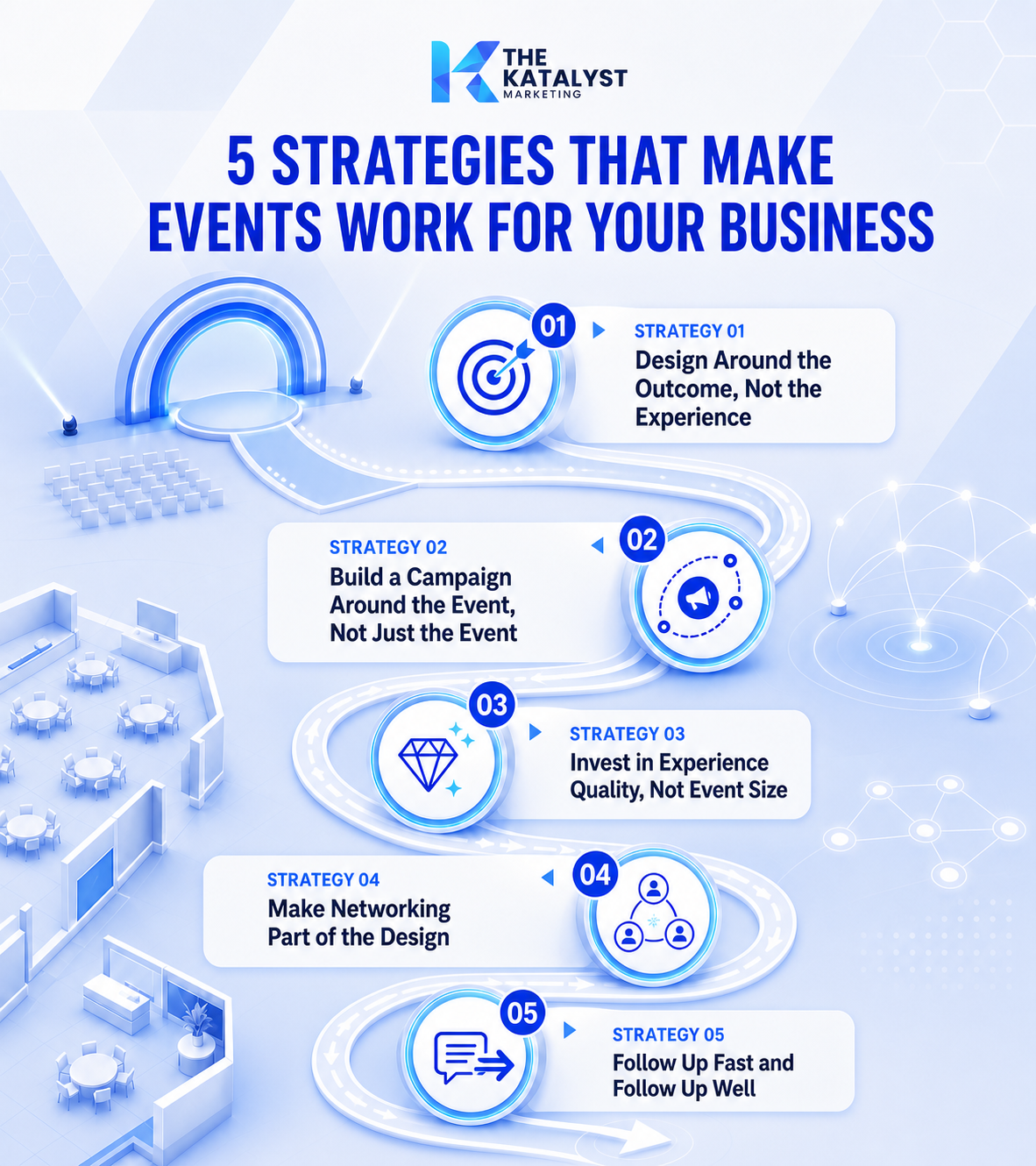
Strategy 1 — Design the Event Around the Outcome, Not the Experience
Work Backward From the Result You Want
Almost all event briefs begin by asking — What type of event would we like to create? Rather, the questions should be: what should our event accomplish, and what type of event will accomplish that? Starting from the goal is going to result in a very different event than one created based on tastes.
If the goal is quality leads, then the event must have formats which promote conversation — roundtables, structured networking, and individual meeting times. If the goal is media exposure, then the event must have an eye-catching design and a news story angle. Business event marketing that starts with the end in mind consistently delivers more than the kind that starts with the venue search.
One Goal Per Event, Not Five
Having too much on the table for one particular event is one of the primary causes for poor performance at such an event. Awareness, lead generation, customer retention, and product launch are four different marketing campaigns. If you try to combine all of them into one event, chances are that you will not accomplish any of them.
Focus on your main business objective and design your entire event around it. An event that is focused on a particular goal and offers a well-designed experience will win every time against an all-purpose event that serves no one well enough.
Strategy 2 — Build a Campaign Around the Event, Not Just the Event Itself
This is the place where most companies miss out big time. The event itself is viewed as the campaign, when in actuality, the event needs to be the core component of a much bigger campaign that happens prior to, during, and even post-day of the event.
Prior to the event, the pre-campaign includes teaser content, countdowns, speaker introductions, and behind-the-scenes looks that create buzz and engage those who aren’t attending the event in person. The pre-event campaign primes your audience for an event worth talking about – even if they aren’t there in person.
On the day of the event, live content (social media posts, video snippets, quotes, and even the live broadcast) shares the experience with an entirely different audience. Those in attendance are just a part of your audience at the event. The people watching from their phones are the other part, and experiential events that plan for both audiences get far more mileage from every hour of the event.
Post-event, the content lifecycle carries on. Highlights, speaker keynotes, attendee quotes, and post-event write-ups keep the discussion going for weeks. It’s usually during this phase when the true business value of the event — where the real leads and deeper connections are made — actually takes place.
Strategy 3 — Invest in Experience Quality, Not Just Event Size
There is a temptation in event management to equate scale with impact. More size. More guests. More money. However, events that make the most impact and have the best commercial results are not necessarily those of a larger scale.
A dinner with carefully chosen thirty decision makers, done with professionalism and hospitality, will yield better business contacts than a big conference where no one can recall whom they talked to. A product launch with the necessary twenty people in attendance will result in more exposure than a busy launch event from which nobody can even see the product.
Conference management and event production quality matter enormously in markets like the UAE, in which the audience is likely to have high expectations based on their experience. The elements of lighting, sound, flow, catering, and design create an overall experience, and the overall experience is directly linked to the perception of the brand.
Strategy 4 — Make Networking Part of the Design
One of the most valuable things any brand event can deliver is connections — between the host brand and its target audience, and between the attendees themselves. However, networking is left up to pure chance, with just an open room and drinks reception in hopes that good conversations take place naturally.
The best business events plan for connections. They set up specific opportunities for the right people to meet each other. They use seating plans, facilitated discussions, and common experiences to encourage conversation. They position the host brand as the connector, the party whose job it is to bring important people together, and this builds huge amounts of goodwill and commercial trust.
When attendees leave an event knowing that they have met the right people and had meaningful conversations, they will attribute their success to the brand that made that possible. This is one of the most impactful ways to build a brand through an event.
Strategy 5 — Follow Up Fast and Follow Up Well
The show is finished. The crowd has been dispersed. The team is tired. This is precisely the time when many organizations fail to capitalize on the success of their event.
Event activation does not end when the lights go off. The follow-up right after an event is when the business results are gained or missed. A quick follow-up on everyone who participated that refers back to a conversation, a moment, or a next step turns the good feelings of the event into tangible business momentum.
Generalized follow-ups three days later to the entire list of attendees accomplish very little. Personalized follow-ups that refer to the actual experience result in much better conversion rates. Including the follow-up process in the event planning process rather than tacking it on afterward — is what separates event planning services that deliver ROI from those that simply deliver events.
Measuring Event Marketing Results the Right Way
Every event marketing investment deserves proper measurement — Not just a head count and a feedback survey. Prior to the event, be very clear about what metrics will tell you whether or not the event achieved its commercial objective.
For lead generation events, this means measuring how many qualified interactions there were, how many follow-up meetings were scheduled, and pipeline built in the thirty days following the event. Awareness events should have metrics around media coverage, social reach, and content engagement for the week afterward. Client retention events should track renewals and upsells in the quarter following the event. Product launch events should track trials, sales lift, and media coverage.
The beauty of this approach is twofold. Not only does it hold the event to a commercial standard, but it also creates valuable learnings for future events.
Conclusion
Event marketing is not a soft marketing activity. If it is done with actual strategic intent behind it – meaning proper goal setting, experience design, campaign surrounding the event, and follow-up – it is among the most powerful growth tools for your business.
Brands and businesses who consider event planning a vital element of their growth strategy – and not just a sporadic nice-to-do – are the ones who always manage to develop better relationships, gather better leads, and produce more content.
If you are ready to start planning events for your business now, contact us. Our Katalyst Event Marketing experts help brands, corporates, and organizations across the UAE and GCC to organize events that are focused on results – every single time.