A Good Promotion Gives the Shopper a Reason to Choose You Today
In a GCC hypermarket aisle, the shopper usually has a few seconds and many options. Most of the brands on the shelf are good products. What changes the decision in that moment is often a reason to act now: a bonus pack, a free gift, a chance to win or a taste of something new. The right consumer promotion strategies create that reason without teaching shoppers to wait for the next discount.
FMCG brand activation and consumer promotions work best together. The activation creates attention and trial, and the promotion gives the shopper a clear benefit for buying. When both are planned around one objective, they can move sales, win new buyers and protect the brand at the same time.
This article looks at the promotion types that work for FMCG brands in the UAE, Saudi Arabia and the wider GCC, how to choose between them and how to avoid the common traps.
Start With the Objective, Not the Mechanic
Many promotions fail because the brand chose the mechanic first. A price cut is easy to run, so it becomes the default. But every mechanic does a different job, and the wrong one can cost margin without delivering the result the brand needs.
Before choosing, answer one question: what should the shopper do differently because of this promotion?
- Try the product for the first time
- Switch from a competing brand
- Buy a larger pack or more units
- Buy more often
- Try a new variant from a brand they already use
Once the behaviour is clear, the right mechanic usually becomes obvious.
The Best Consumer Promotion Strategies for FMCG Brands
1. Sampling and Product Trial
For new products and new variants, nothing replaces letting the shopper taste, smell or try the product. In-store sampling, mall activations and sampling at events remove the risk of buying something unknown. Sampling works best when it is linked to an immediate reason to buy, such as a voucher or an offer at the shelf a few metres away.
2. Bonus Packs and Extra Volume
Offering more product for the same price, such as an extra quantity in the pack, gives value without cutting the price on the shelf. This protects the price image of the brand and works well for categories where shoppers compare value per unit.
3. Bundles and Multi-Buy Offers
Bundling two products together, or offering a better deal when the shopper buys more than one, increases basket size. Bundles are also a smart way to introduce a new variant by pairing it with a best seller the shopper already trusts.
4. Gift With Purchase
A useful, branded or seasonal gift attached to a purchase can be more memorable than a discount of similar cost. In the GCC, gifts that fit seasonal moments, such as Ramadan or back to school, often feel more relevant to families than a simple price reduction.
5. Temporary Price Reductions
Price promotions have a place, especially when the goal is to win switchers in a competitive category or to clear stock. The risk is that frequent price cuts train shoppers to buy only on promotion. Use them in planned windows rather than all year round.
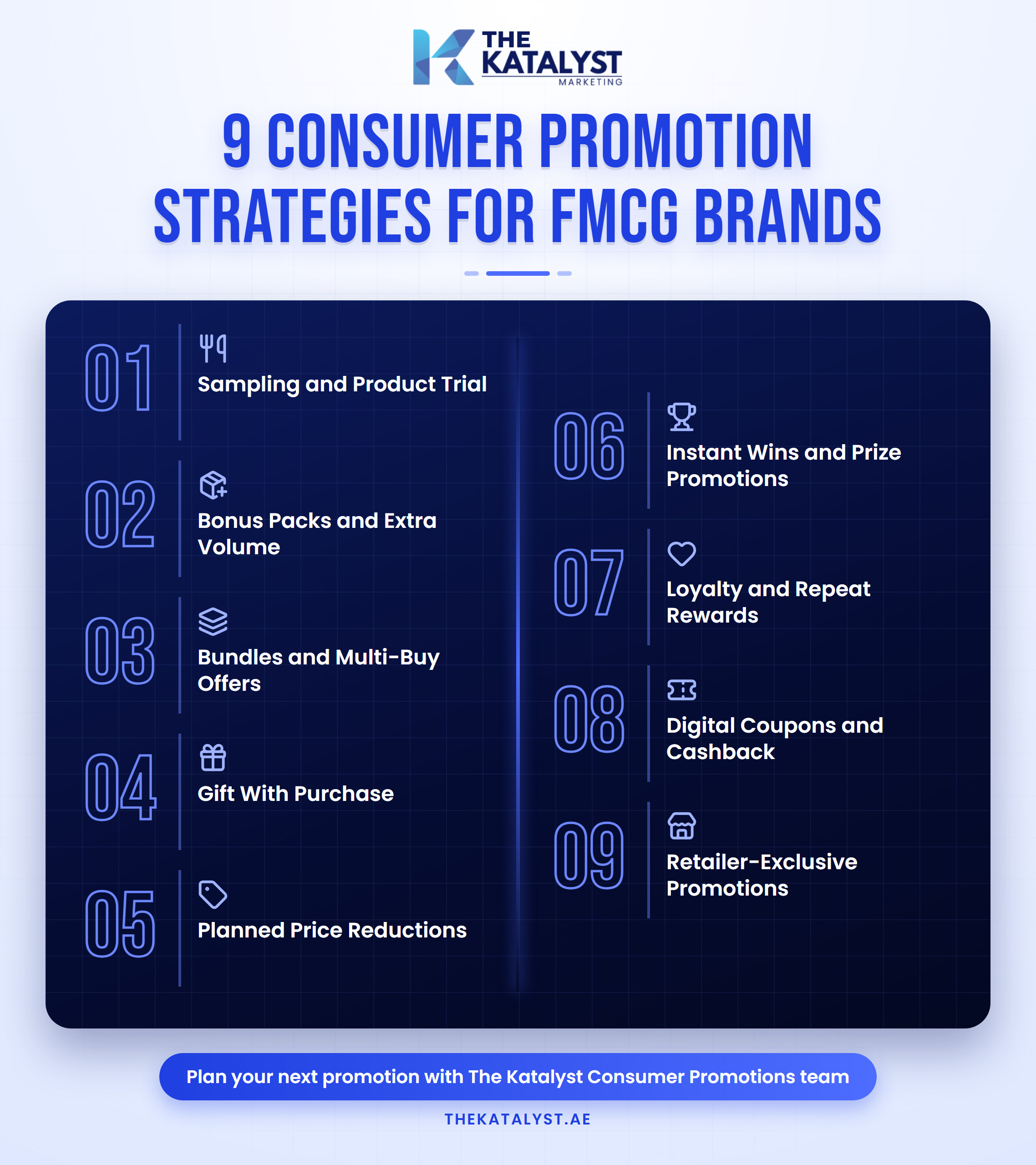
6. Instant Wins, Competitions and Prize Promotions
Scratch cards, instant win mechanics and prize draws add excitement and can generate strong engagement, especially when linked to a digital entry through a QR code. These promotions usually need approval from the relevant authority in each market, so the rules and timing should be checked early with the authority or a qualified advisor before anything is printed.
7. Loyalty and Repeat Purchase Rewards
Collect-and-win mechanics, stamps, points and rewards for repeat purchases help turn first-time buyers into regular ones. Many retailers in the region run their own loyalty programmes, and working with them can give a brand targeted offers and better data.
8. Digital Coupons and Cashback
Digital coupons, receipt upload campaigns and cashback offers connect the in-store purchase with a digital journey. They also give brands something many traditional promotions do not: data on who bought and when. That makes sales promotion campaigns easier to measure and improve.
9. Retailer-Exclusive Promotions
Creating a promotion exclusively with one retailer can secure better display space, a gondola end or inclusion in the retailer’s leaflet. For many FMCG promotions GCC plans, these joint campaigns are the key to gaining visibility in busy stores.
Using the GCC Calendar to Time Promotions
Retail promotions Middle East brands run are strongly shaped by the calendar. Ramadan and the two Eids change what families buy and how often they shop. National Days in each GCC country create strong patriotic moments. Back to school, summer travel and major retail festivals also change shopping patterns.
Because Ramadan and the Eids follow the Islamic calendar, they move earlier each year. Planning promotions, stock and in-store staff around these moments well in advance is one of the most effective FMCG marketing strategies a brand can follow. Promotions designed for these moments should respect the tone of the season, especially during Ramadan.
Making Promotions Work in Store
A strong promotion can still fail if shoppers do not notice it. Shopper promotions UAE retailers run compete with many others in the same aisle, so execution matters.
- Make the offer clear in a few words that can be read from a distance
- Place the promotion where the shopper decides, at the shelf or a gondola end
- Use trained promoters to explain the offer and answer questions
- Check stock levels daily so the promotion never runs out halfway
- Show the offer in both Arabic and English where the audience needs it
Our guide on how brands use in-store promotions to increase sales covers execution in more detail.
Common Mistakes With Consumer Promotions
Discounting Too Often
When a brand is on promotion more often than not, the promoted price becomes the real price in the shopper’s mind. This weakens the brand and makes full-price sales harder.
Ignoring the Rules
Consumer promotions UAE and Saudi brands run, especially discounts, prize draws and competitions, are regulated. Requirements differ by emirate and by country, so confirm the approvals needed with the relevant authority before launch.
Not Measuring the Result
Without a baseline and a clear way to track incremental sales, it is impossible to know whether a promotion paid back. Measure sales before, during and after the promotion, and watch for a dip once it ends. If you want help building promotions that are planned and measured properly, talk to our team.
Conclusion
The best consumer promotion strategies are not always the biggest discounts. They are the promotions that match a clear objective, give the shopper a real reason to act, fit the GCC calendar and are executed well at the shelf. Sampling, bonus packs, bundles, gifts, loyalty rewards and digital mechanics each have a role, and the strongest plans use them together over the year.
For more on building long-term value, see our article on how consumer promotions increase brand loyalty. If you are planning promotions for the UAE, Saudi Arabia or the wider GCC, reach out to our team today. The Katalyst works with FMCG brands across the region to design and deliver promotions and activations that drive real sales, from the first brief to the final report.
FAQs
Q1. What are consumer promotion strategies?
Consumer promotion strategies are planned offers aimed directly at shoppers to encourage a specific action, such as trying, switching or buying more. Common examples include sampling, bonus packs, bundles, gifts with purchase, price reductions, instant wins and loyalty rewards.
Q2. Which consumer promotion works best for a new FMCG product?
Sampling linked to an immediate reason to buy is usually the strongest option for a new product, because it removes the risk of trying something unknown. Pairing the new product with an existing best seller in a bundle can also help.
Q3. Are price discounts a good promotion strategy?
Price discounts can win switchers and move stock, but used too often they train shoppers to wait for offers and reduce the value of the brand. They work best in planned windows alongside value-adding mechanics such as bonus packs or gifts.
Q4. When should FMCG brands run promotions in the GCC?
Ramadan, Eid Al Fitr, Eid Al Adha, National Days, back to school and major retail festivals are key moments. Because Ramadan and the Eids follow the Islamic calendar, their dates move each year, so plans should be built well in advance.
Q5. Do consumer promotions in the UAE need approval?
Many types do, particularly discounts, prize draws and competitions. The requirements depend on the emirate and the type of promotion, so brands should confirm them with the relevant authority, such as the Dubai Department of Economy and Tourism in Dubai, before launching.